
Sacred Geometry Symbols: Meanings, Best Placements, and Hidden Pitfalls
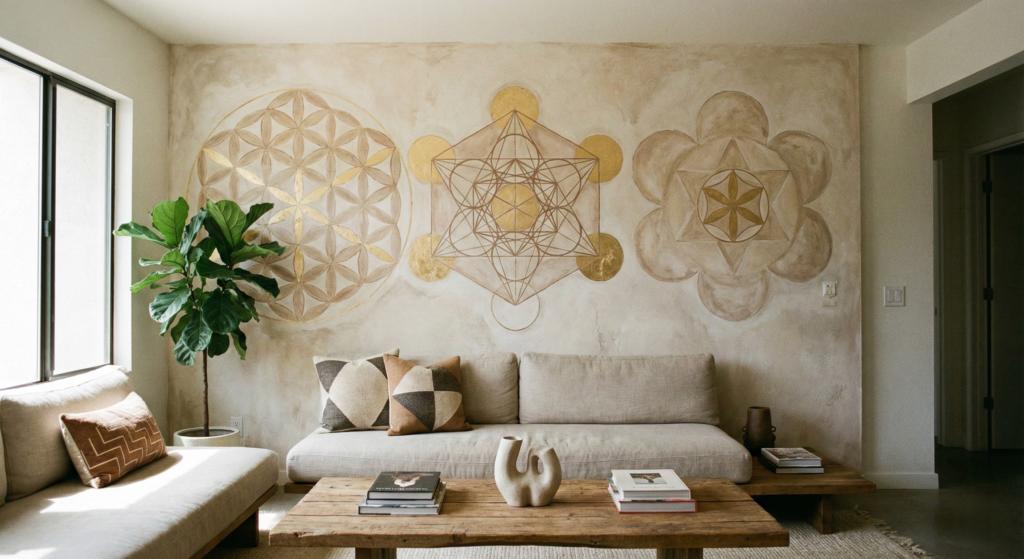
Take a closer look at nature — the spiraling of a fern, the honeycomb of a beehive, the symmetry of a snowflake. Beneath everything alive lies a quiet mathematical rhythm, one that artists, mystics, and scientists have marveled at for centuries.
That rhythm is known as Sacred Geometry — the divine language of patterns, shapes, and proportions that underlie all creation.
But this isn’t just ancient symbolism. In our fast-paced, digital age, these timeless forms are resurfacing — not as superstition, but as powerful tools for healing, focus, and connection in a world that often feels fragmented. Let’s explore what sacred geometry truly means, where it came from, and how its 20 most powerful patterns continue to shape modern consciousness and personal growth.
Table of Contents
ToggleWhat Is Sacred Geometry?
At its heart, sacred geometry is the study of the energetic and mathematical principles that form the structure of life itself. It is based on the idea that everything in existence — from a single atom to a spiral galaxy — follows precise geometric patterns. These patterns are found in art, architecture, music, and the molecular structures of our DNA. Across cultures, they have been used to symbolize balance, unity, and the divine order of the cosmos. In essence, sacred geometry shows that creation is not random; it is meticulously designed.
Why Ancient Civilizations Honored Geometry
Long before modern science, civilizations recognized geometry as a sacred key:
Egyptians built pyramids aligned with precise cosmic and earth-bound proportions.
Greeks studied the Platonic solids as the foundational shapes of the elements.
Hindus and Buddhists created yantras and mandalas for deep meditation and cosmic alignment.
Celts wove intricate knotwork to symbolize eternity and the continuity of life.
Native American tribes used spirals and circles to represent life cycles and the balance of nature.
Each culture gave these patterns different names and meanings, but they all pointed to the same truth: geometry is the invisible architecture of existence.
20 Common Sacred Geometrical Symbols and Their Meanings
To truly harness the power of sacred geometry, we must start with the foundational building blocks of the universe and move toward the most complex cosmic blueprints. Here are the 20 most profound sacred geometry symbols and what they represent.
1. The Circle The most fundamental of all shapes, the circle represents unity, wholeness, and eternity. It has no beginning and no end, making it the universal symbol for the infinite nature of energy and the divine.
2. The Triangle The triangle is the symbol of balance, ascent, and harmony. Pointing upward, it represents the ascent of consciousness and masculine energy; pointing downward, it embodies the divine feminine and grounded creation. It is the geometric expression of the mind, body, and spirit connection.
3. The Square Representing earth, the square is the ultimate symbol of grounding, stability, and structure. It is the foundation upon which the material world is built, providing safety, boundaries, and a solid base for spiritual expansion.
4. The Hexagon Found perfectly formed in beehives and snowflakes, the hexagon represents structure, connection, and unification. It is the shape of maximum efficiency and harmony, illustrating how individual parts can lock together to create a unified, unbreakable whole.
5. The Spiral (Fibonacci Sequence) The spiral — dictated by the mathematical Fibonacci sequence — represents growth, evolution, and the universal life force. Found in seashells, hurricanes, and galaxies, the spiral teaches us that evolution follows a natural rhythm. It is a reminder that true progress in life unfolds organically, rather than being forced.
6. The Pentagram Often misunderstood, the five-pointed star is an ancient symbol representing the five elements: earth, air, fire, water, and spirit. It is a powerful emblem of protection, human potential, and the integration of the physical body with the soul.
7. The Vesica Piscis Formed by two overlapping circles, the Vesica Piscis is the symbol of duality and creation. The almond-shaped intersection where the circles meet represents the union of opposites — spirit and matter, male and female, heaven and earth. It reminds us that true creation arises when two forces come into perfect harmony.
8. The Seed of Life Created by seven overlapping circles, the Seed of Life is a geometric depiction of the seven stages of creation. It is the universal symbol of new beginnings, fertility, and the divine blueprint. It is a powerful shape for those starting a new chapter in life.
9. The Egg of Life Derived from the Seed of Life, the Egg of Life is a cluster of eight spheres that perfectly mirrors the cellular division of a human embryo. It represents health, physical vitality, and the biological genesis of life itself.
10. The Flower of Life One of the most universal symbols of sacred geometry, the Flower of Life contains the patterns of creation as they emerge from the Great Void. It represents the infinite interconnection of all things and the cosmic grid that connects every living being.
11. The Fruit of Life Hidden within the Flower of Life is the Fruit of Life, a pattern of 13 circles. It is considered the blueprint of the universe, containing the basis for the design of every atom, molecular structure, and life form in existence.
12. Metatron’s Cube Derived from the Fruit of Life, Metatron’s Cube contains all five Platonic solids — the basic building blocks of the material world. It represents ultimate balance, creation, and protection. In energy work, it is used to clear stagnant energy and restore natural flow to the body and environment.
13. The Merkaba (Star Tetrahedron) The Merkaba is an energetic light vehicle represented by two intersecting tetrahedrons (a three-dimensional Star of David). It symbolizes the harmonization of male and female energy and is used in advanced meditation to elevate consciousness and facilitate spiritual transformation.
14. The Golden Ratio (Phi) Often called the divine proportion (approximately 1.618), the Golden Ratio defines the perfect balance between order and beauty. From the Parthenon to the human face, this proportion reflects divine harmony — the exact point where logic meets intuition.
15. The Torus The Torus is a self-sustaining, doughnut-shaped energy field that exists around atoms, planets, and the human heart. It symbolizes infinite flow and magnetic balance. It illustrates the universal law of reciprocity: what flows out eventually flows back in.
16. The Labyrinth Unlike a maze designed to confuse, a labyrinth has only one winding path that leads to the center and back out again. It symbolizes the spiritual journey, psychological transformation, and the return to the core self.
17. The Mandala Sanskrit for “circle,” the mandala represents the universe and psychological wholeness. Used extensively in Eastern traditions and modern art therapy, mandalas help individuals find focus, calm the nervous system, and integrate fragmented parts of the psyche.
18. The Celtic Knot With its endless interwoven loops, the Celtic Knot has no beginning and no end. It represents eternity, the interconnected threads of fate, and the continuity of life, death, and rebirth.
19. The Tree of Life Rooted in Kabbalistic tradition, the Tree of Life is a geometric framework of 10 interconnected spheres (Sephiroth). It maps out the creation of the universe, the flow of divine energy into the physical realm, and the psychological landscape of the human soul.
20. The Sri Yantra In Vedic spirituality, the Sri Yantra is an intricate diagram of nine interlocking triangles radiating from a central point. It embodies the union of the divine masculine and feminine. Meditating on it is said to align the mind with higher consciousness and profound manifestation.
The Role of Sacred Geometry in Modern Life
Though these symbols emerged in ancient temples, sacred geometry is not frozen in time. Today, it is woven into art, technology, healing, and personal development.
Architecture and Design Modern architects use sacred geometric ratios to create spaces that feel inherently “right.” Buildings constructed using the Golden Ratio or Fibonacci patterns feel naturally balanced and emotionally harmonious to the human nervous system.
Meditation and Mindfulness Tracing, coloring, or visualizing shapes like the Mandala or the Torus are powerful mindfulness tools. Focusing on geometric symmetry quiets the mind, synchronizes the brain’s hemispheres, and anchors awareness in the present moment.
Energy and Healing Practices Sacred geometry is foundational in holistic healing. Practitioners believe these shapes carry specific frequencies that restore balance to the body. For example, the Flower of Life is often used on healing grids, while the Torus inspires heart-coherence breathing techniques.
Sacred Geometry for Wealth and Money Attraction Sacred geometry can be actively used for manifestation and unblocking financial flow. Because these shapes hold the highest, most stable frequencies in the universe, they are powerful tools for aligning your personal energy with the frequency of abundance. When you are trapped in a “lack mindset,” your energetic field becomes chaotic. Geometric symbols act as tuning forks, bringing your vibration back into a state of harmonious flow where wealth can easily reach you.
Metatron’s Cube for Clearing Blockages: Spinning this symbol through your mind’s eye helps clear deep-seated limiting beliefs and stagnant financial energy.
The Flower of Life for Expansion: As the ultimate symbol of infinite creation, keeping this pattern near your workspace signals to the universe that you are open to multiplying your resources.
The Sri Yantra for Material Wealth: Associated with prosperity, meditating on the central point of this yantra magnetizes both material and spiritual wealth by dissolving poverty consciousness.
Digital Art and Conscious Creativity From corporate logo design to digital media, modern creators use sacred geometry to express balance and evolution. The visual appeal of these proportions transcends time, culture, and belief.
Personal and Spiritual Growth On a personal level, working with sacred geometry is a reminder to live in alignment — to find structure without rigidity, and movement without chaos. These forms teach us how to create, relate, and evolve gracefully.
Bringing Sacred Geometry into Your Daily Life
You do not need to be an architect or a mystic to feel the benefits of sacred geometry. Here are practical ways to weave these principles into your daily routine:
Curate Your Space: Use sacred symbols as wall art or desktop backgrounds to create calming, high-vibe environments.
Mindful Creativity: Draw or color mandalas as a daily exercise to reduce anxiety and process complex emotions.
Wear Intentional Jewelry: Keep shapes like the Merkaba, the Seed of Life, or a Hexagon close to your body to remind yourself of unity and flow.
Mental Resets: Trace a spiral or a labyrinth with your finger when you need to ground your energy during a stressful workday.
Frequently Asked Questions
1. What are the most widely used sacred geometry symbols?
The most universally recognized sacred geometry symbols include the Flower of Life, the Seed of Life, Metatron’s Cube, and the Sri Yantra. These intricate patterns are found throughout nature, ancient architecture, and modern design, serving as the foundational energetic blueprints of the universe.
2. How can I learn and apply sacred geometry meanings?
Understanding sacred geometry meanings requires looking at the energetic intention behind each pattern. For instance, the Fibonacci Spiral dictates natural growth and manifestation, while the Torus represents infinite energy flow. Knowing these specific meanings allows you to use the patterns intentionally to attract wealth, foster love, or deepen your meditation practice.
3. Are all sacred geometry shapes suitable for any room?
While sacred geometry shapes inherently carry positive, high-vibrational energy, their placement is crucial. Highly active, spinning shapes like Metatron’s Cube or the Merkaba can be far too stimulating for restful areas like bedrooms and may cause insomnia. You must match the shape’s specific frequency with the intended purpose of the room.
4. Which of these are the best spiritual symbols for home harmony and protection?
If you are specifically seeking spiritual symbols for home environments, the Flower of Life is unmatched for central living spaces because it promotes profound unity and harmony among family members. For energetic protection, placing Metatron’s Cube or a Celtic Shield Knot near your front door acts as a powerful barrier against negative energy entering your space.
5. Are there mental health benefits to interacting with sacred geometry?
Yes, engaging with sacred geometry shapes is highly beneficial for your mental well-being. The intricate, symmetrical patterns help to center the mind and promote deep psychological harmony. In fact, psychological experts note that creating or simply viewing mandalas can significantly reduce anxiety, help process difficult emotions, and act as a powerful tool for grounding and spiritual repair.
Reconnecting With the Cosmic Blueprint
Sacred geometry is far more than lines and circles—it is a living language that speaks through beauty, proportion, and form, whispering of unity where we often see only separation and chaos. In our fast-paced, fragmented modern world, these ancient patterns serve as a profound reminder to slow down and reconnect with the intelligent order woven through every heartbeat. Ultimately, when we begin to recognize the sacred geometry of life, we finally see ourselves not as isolated beings, but as essential, interconnected pieces of a masterful cosmic design.
About the Author
Cosmic Signs Daily Editorial Board
The Cosmic Signs Daily Editorial Board ensures every article is researched, fact-checked, and reviewed for accuracy. Our team relies on precise astronomical data to provide grounded and reliable spiritual guidance.
Follow our journey on Pinterest.
Disclaimer
The information provided in this article is intended for educational and reflective purposes only. Astrology is interpretive and symbolic in nature; it should not be regarded as a guarantee of outcomes. This content does not constitute professional financial, legal, medical, or psychological advice. Decisions remain solely your responsibility. For guidance on specific circumstances, please consult a qualified professional. Read full Terms & Conditions.