
Mindful Interior Design:
Finding Your Spiritual Decor Style
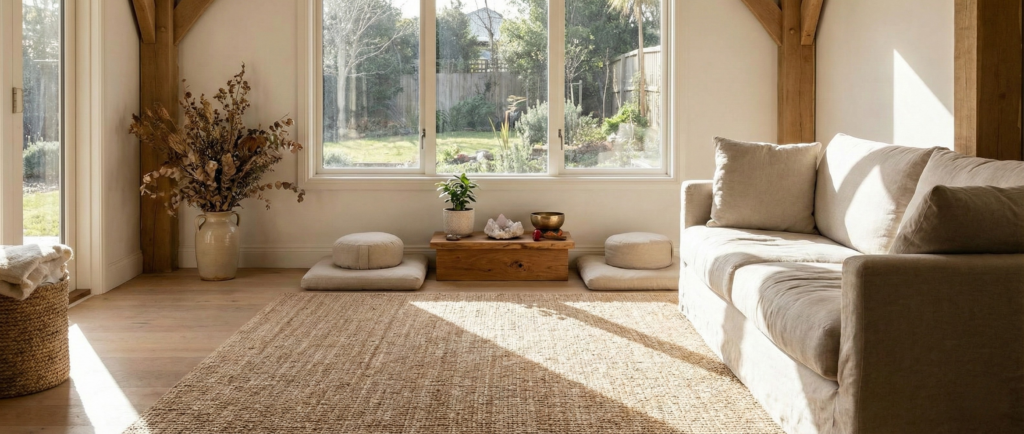
Your home is the most intimate space you inhabit. It holds the residue of your days — the stress you carry through the front door, the stillness you try to find before sleep, the rituals that keep you anchored when life feels unsteady. And yet most of us design our homes almost entirely on autopilot, choosing what looks appealing online without ever asking the deeper question: what does this space need to do for me?
Mindful interior design begins with that question. It is the practice of building environments that actively support your mental, emotional, and spiritual wellbeing — not merely spaces that photograph well, but spaces that genuinely feel like coming home to yourself.
The key insight that separates mindful design from conventional decorating is this: different design philosophies create fundamentally different energetic frequencies. A space built around Zen principles does not feel the same as one built around Biophilic design, even if both are described as “calming.” The distinction matters enormously, because what your nervous system needs in this particular season of life is specific. A scattered, overstimulated mind needs something different from an emotionally heavy, withdrawn one. A creative soul needs something different from a disciplined practitioner.
This guide walks through the five most powerful spiritual design philosophies available to Western homes today, the unique energetic frequency each one creates, and how to choose — and implement — the one that genuinely fits where you are right now.
Table of Contents
ToggleWhy Your Environment Shapes Your Inner State
Before exploring the styles themselves, it is worth understanding the mechanism behind why this works at all.
Environmental psychology — a well-established field of research — has documented extensively that our physical surroundings have a direct and measurable impact on our cognitive function, emotional regulation, and stress response. The colors on your walls influence your neurochemistry. The quality of light in a room affects your cortisol levels. The amount of visual clutter in your field of vision actively taxes your working memory, even when you are not consciously aware of it.
This is not mysticism. It is physiology. And it is the scientific foundation beneath what spiritual traditions have understood for centuries: that the spaces we inhabit either support or undermine our capacity to be fully present, emotionally regulated, and spiritually open.
When you design your home with intention — when every material, every object, and every arrangement serves a deliberate purpose — your environment stops being something you move through and becomes something you draw energy from.
1. Japandi: The Energy of Grounded Clarity
Japandi is perhaps the most influential design movement in Western interiors over the past decade, and with good reason. It is the meeting point between two philosophies that, at first glance, seem culturally distinct but are spiritually aligned: the refined minimalism of Japanese aesthetics and the warm, functional coziness of Scandinavian hygge.
The result is a design language built around clean, uncluttered lines, a muted palette of warm neutrals and soft earth tones, and a deep respect for the quality and authenticity of natural materials. Light oak, bamboo, linen, stone, and unglazed ceramic are the building blocks of a Japandi space. Nothing is ornate. Nothing is excessive. Every object earns its presence by being both beautiful and functional.
The energetic frequency Japandi creates is one of mental clarity and nervous system regulation. In a well-executed Japandi room, visual noise is reduced to near zero. The eye has nowhere to snag, nothing to process beyond the quiet beauty of natural grain and honest material. For people whose minds run fast — who carry the weight of decision fatigue, overthinking, or chronic low-level anxiety — this reduction of visual stimuli is profoundly calming. The room itself does the work of quieting the mind that meditation is trying to achieve.
Bringing Japandi into your home begins with subtraction rather than addition. Declutter ruthlessly and let surfaces breathe. Choose natural wood furniture with simple, tapered lines in pale oak or walnut tones. Replace synthetic textiles with high-quality linen cushions and throws in oat, warm grey, or sage. Ground the space with a low-profile jute or wool rug and keep decorative objects to a minimum — one or two pieces of handmade ceramic carry more weight than a shelf full of trinkets.
Astrologically, the structured serenity of Japandi resonates most deeply with earth signs — Taurus, Virgo, and Capricorn — who are nourished by order, quality, and the quiet beauty of natural things. But it serves anyone whose daily environment is loud and whose home needs to be its direct opposite.
2. Spiritual Bohemian: The Energy of Creative Expansion
Where Japandi whispers, Spiritual Bohemian speaks. This is the design philosophy of abundance, layering, and unapologetic self-expression — a space that does not conceal the inner world of its inhabitant but celebrates it openly.
A spiritually oriented Boho home is rich with texture, warm with color, and alive with the energy of the objects it holds. Macramé wall hangings, woven rattan furniture, floor cushions, trailing houseplants, and open shelving displaying crystals, tarot decks, incense, and collected objects from meaningful places — all of it coexists in a layered, eclectic harmony that has no interest in matching or conforming to a single visual rule.
The energetic frequency Spiritual Boho creates is one of joy, flow, and creative vitality. This style does not try to control energy — it invites it to move freely through the space. Walking into a well-curated Boho room tends to activate the imagination and lift the mood. It is a space that says: all of you is welcome here.
Building a Spiritual Boho space starts with colour and layering. Introduce warm, earthy jewel tones — terracotta, burnt amber, deep teal, dusty rose — through embroidered velvet cushions, woven wall art or tapestries, and patterned throws. Add a dedicated crystal display — a tiered shelf or wooden tray where your amethyst clusters, selenite wands, and personal pieces are arranged with intention rather than hidden away. Layer rugs on top of each other for warmth and depth, and let plants grow abundantly wherever light allows.
This style is a natural home for fire and water signs — the passionate, expressive, emotionally rich Aries, Leo, Sagittarius, Cancer, Scorpio, and Pisces archetypes. But more broadly, it suits anyone who draws energy from their environment rather than seeking relief from it, and anyone whose creative or spiritual life needs a space that visibly honours it.
Elevate Your Space With Intentional Objects
Every design philosophy here is brought to life through the objects you choose. The right crystal on your shelf, the right lamp casting the right light — these are not just decorative decisions. They are energetic ones.
Conscious Items offers ethically sourced crystals, crystal lamps, and zodiac décor designed for those who take their space — and their spiritual practice — seriously.
Shop Intentional Décor →✦ Free shipping available · ✦ Ethically sourced · ✦ Loved by 500,000+ customers
3. Traditional Zen: The Energy of Deep Stillness
If Spiritual Boho is the design philosophy of expression, Traditional Zen is its polar opposite — and equally powerful for those it suits. Rooted in Buddhist philosophy and refined over centuries of Japanese monastic and domestic practice, Zen interior design is the pursuit of absolute simplicity as a spiritual discipline in itself.
This is not minimalism as an aesthetic trend. It is minimalism as a philosophical commitment to the idea that when everything unnecessary has been removed, what remains carries an incomparable quality of presence. A Zen room is not sparse because it lacks imagination — it is sparse because every object, surface, and proportion has been considered with extraordinary care.
Zen spaces use low-profile furniture that keeps the centre of gravity close to the ground and the sightlines open. The palette is strictly neutral — warm whites, natural stone, unbleached linen, dark wood. Negative space — the intentional emptiness between and around objects — is treated as a design element in its own right, as essential as any piece of furniture. A single focal point anchors the room: a bonsai tree, a tabletop water feature, or a piece of calligraphy brushed on handmade paper.
The energetic frequency Zen design creates is one of deep introspection and disciplined stillness. By removing all external distraction, the room creates conditions in which the mind has no option but to turn inward. It is the ideal environment for a serious, consistent meditation practice, for shadow work, or for any form of inner inquiry that requires genuine quiet.
This style suits those seeking spiritual discipline over spiritual decoration — people who want their home to be a container for practice rather than an expression of personality. Astrologically, air signs — Gemini, Libra, and Aquarius — often benefit most from this severe reduction of stimuli, as it quiets the relentless mental activity that characterises the air archetype.
4. Biophilic Design: The Energy of Earth Connection
Biophilic design is grounded in a simple and well-documented truth: human beings evolved in nature, and our nervous systems still expect it. The built environments of modern life — artificial lighting, synthetic materials, sealed interiors with no connection to the outside world — are a biological novelty that our bodies have not caught up with. Biophilic design works to close that gap.
This philosophy goes significantly further than placing a few houseplants on a windowsill. In its fullest expression, biophilic design means maximising natural light through sheer curtains or light-filtering blinds that bring the outdoor light cycle inside. It means choosing furniture and materials that are genuinely natural — solid wood with visible grain, raw stone surfaces, clay, cork, and wool rather than their synthetic alternatives. It means favouring organic, curved shapes over sharp geometric angles, which mirror the forms found in nature and are processed by the brain as inherently safer and more restful. And it means incorporating the sounds and presence of water where possible — a small indoor water fountain does more for the nervous system than most people expect.
The energetic frequency biophilic design creates is one of physical and emotional restoration. Research published across environmental psychology and neuroscience literature consistently shows that time spent in high-quality natural environments — and spaces that evoke them — lowers cortisol, reduces blood pressure, improves sleep quality, and restores cognitive function depleted by sustained attention and screen exposure.
Spiritually, biophilic design is a form of daily grounding. It keeps you tethered to the rhythms of the natural world even when city life makes direct contact with nature difficult. Abundant, thriving houseplants — pothos, monstera, peace lily, snake plant — are the most accessible expression of this philosophy and one of the highest-return investments you can make in any space.
This style is a universal healer. It is particularly powerful for anyone experiencing burnout, urban fatigue, chronic disconnection, or the kind of low-grade spiritual depletion that comes from spending too much time indoors and too little time in contact with living things.
5. Wabi-Sabi: The Energy of Radical Acceptance
Of all the design philosophies here, Wabi-Sabi is perhaps the most quietly radical — because it asks something of you that contemporary Western culture rarely does. It asks you to stop trying to make everything perfect.
Wabi-Sabi is a traditional Japanese aesthetic rooted in the Buddhist concepts of impermanence and incompleteness. It finds beauty not in the polished and the pristine but in the weathered, the irregular, and the imperfect. A Wabi-Sabi home does not attempt to look like a showroom. It looks like a life being genuinely lived.
In practice, this translates to embracing natural materials that show their history — a dining table with visible wood knots and natural imperfections, handmade pottery with uneven glazes, linen that crinkles, plaster walls with slight texture and variation. Objects that have been repaired rather than replaced. Art that is handmade rather than mass-produced. A patina of time and use that is treated as beauty rather than something to be corrected.
The energetic frequency Wabi-Sabi creates is one of permission and peace. A room built on these principles communicates continuously and subliminally that things do not have to be flawless to be worthy. That impermanence is not a problem to be solved but a reality to be accepted. For those doing deep inner work — healing from perfectionism, navigating major life transitions, or simply trying to be gentler with themselves — this is an extraordinarily supportive environment to live and practice in.
Raw, unpolished crystals fit beautifully into a Wabi-Sabi aesthetic — their natural formations and irregular surfaces embody the philosophy directly. A hand-thrown ceramic incense holder, a piece of driftwood, a linen meditation cushion — these are the objects of a Wabi-Sabi sanctuary.
How to Choose the Right Style for Where You Are Now
The most important instruction in this entire guide is this: design for your current season, not your ideal self.
It is tempting to choose a design style based on who you aspire to be — the disciplined meditator who thrives in a Zen room, or the effortlessly grounded person whose biophilic home is full of thriving plants. But the most powerful spaces are built for who you genuinely are right now, and what you genuinely need in this particular chapter of your life.
If your mind is overwhelmed and racing, Japandi or Zen will serve you better than Boho, regardless of which you find more beautiful online. If your spirit feels flat and your creativity has stalled, the vibrant layering of Spiritual Boho will nourish you in ways that a sparse Zen room simply cannot. If you are moving through grief, loss, or a difficult transition, the gentle acceptance of Wabi-Sabi may offer more genuine comfort than any other aesthetic.
You do not need to commit to a single style permanently, and you do not need to implement everything at once. Begin with the one principle from your chosen philosophy that resonates most immediately — a shift in lighting, a single piece of meaningful art, one quality natural object placed with care — and let the space evolve from there.
The most spiritually alive homes are never finished. They are always becoming, always reflecting the growth and changing needs of the person who inhabits them. That is not a design flaw. That is the point.
Frequently Asked Questions
1. What is the difference between Japandi Interior Design and Zen Interior Design?
While both styles prioritize minimalism and a sense of calm, they have different energetic focuses. Japandi Interior Design blends Japanese elegance with Scandinavian warmth, using light woods and cozy textiles to create a highly functional, comforting environment. Zen Interior Design is much stricter; it relies heavily on “negative space” and the absolute removal of all unnecessary objects to encourage deep contemplation and spiritual discipline.
2. How does Biophilic Design improve mental well-being?
Biophilic Design goes beyond just decorating with houseplants; it is an architectural approach that brings the healing frequencies of nature indoors by maximizing natural light, organic shapes, and raw materials. According to psychological research, spending time in environments with high biophilic quality lowers stress hormones, enhances cognitive function, and significantly improves overall emotional well-being.
3. Why is Wabi Sabi Interior Design becoming so popular?
In a culture that often demands perfection, Wabi Sabi Interior Design offers a deeply healing alternative. Rooted in ancient Japanese philosophy, this style celebrates the beauty of imperfection and the natural aging process of materials. People are drawn to it because it provides a psychological sanctuary where you do not have to be flawless to feel comfortable and at peace.
4. Can mindful interior design really change the energy of a room?
Absolutely. The aesthetic you choose directly dictates how a room feels and functions. A chaotic, cluttered room will naturally breed a chaotic mind, whereas intentionally choosing a style that matches your spiritual needs—whether that is the vibrant energy of a Boho space or the grounding clarity of Japandi—acts as a daily anchor for your mental health and personal growth.
Deepening Your Practice
Once you have identified the design philosophy that resonates with your current season, the next step is personalisation. Your astrological birth chart is a detailed map of your energetic preferences — the colors, textures, elements, and spatial arrangements that support your particular frequency rather than a generic idea of what “calm” or “energised” should look like.
Explore our Zodiac Aesthetics Style Guide to discover the specific design language of your sun sign. Pair your chosen style with intentional crystal placement to amplify the energetic frequency you are building toward, and read our guide to Spiritual Grounding and Earth Connection for the daily practices that keep your body anchored in whatever space you create.
Your home is not separate from your spiritual life. It is one of its most consistent and powerful expressions.

About the Author
Cosmic Signs Daily Editorial Board
The Cosmic Signs Daily Editorial Board ensures every article is researched, fact-checked, and reviewed for accuracy. Our team relies on precise astronomical data to provide grounded and reliable spiritual guidance.
Follow our journey on Pinterest.
Disclaimer
The information provided in this article is intended for educational and reflective purposes only. Astrology is interpretive and symbolic in nature; it should not be regarded as a guarantee of outcomes. This content does not constitute professional financial, legal, medical, or psychological advice. Decisions remain solely your responsibility. For guidance on specific circumstances, please consult a qualified professional. Read full Terms & Conditions.