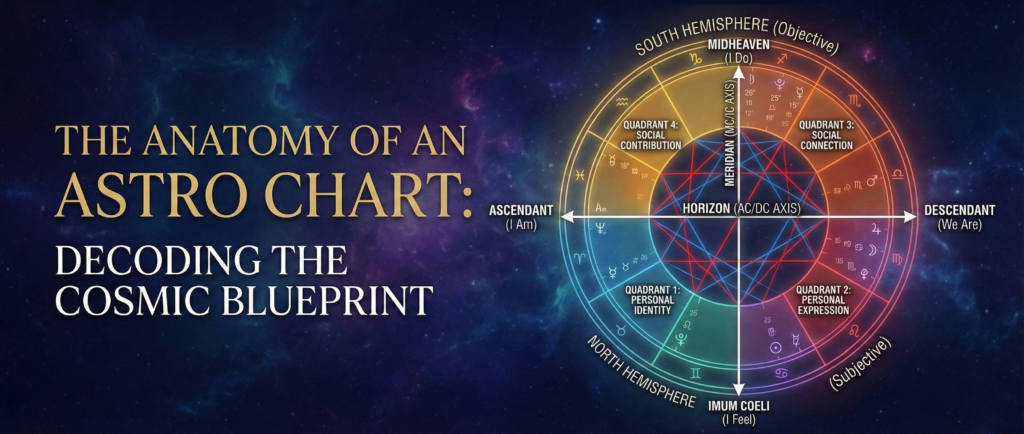
When you generate your Astro Chart, the first thing you notice isn’t the planets—it’s the geometry. You see a circle sliced into pie pieces , a horizon line cutting across the middle, and strange glyphs scattered around the edge.
While our Guide to Reading Birth Chart Archetypes explains who the characters are, this guide explains the stage they are standing on.
To truly understand your Natal Chart, you have to look past the symbols and see the structure. The specific layout of your chart—where the planets cluster and how the wheel is divided—reveals the “skeleton” of your personality before you even read a single sign.
Here is your guide to the anatomy of an Astrology Chart.
1. The Two Main Axes: The Cross of Matter
Every Birth Chart is anchored by a giant cross in the center. These two lines represent the four cardinal points of your existence.
The Horizontal Axis (The Horizon)
This line represents awareness.
-
Left Point (Ascendant/AC): “I Am.” The sunrise moment. This is your body, your mask, and how you initiate things.
-
Right Point (Descendant/DC): “We Are.” The sunset moment. This is your partners, your enemies, and who you attract.
The Vertical Axis (The Meridian)
This line represents power.
-
Top Point (Midheaven/MC): “I Do.” The highest point in the sky. This is your career, reputation, and public legacy.
-
Bottom Point (Imum Coeli/IC): “I Feel.” The roots of the chart. This is your home, ancestry, and private self.
(For a step-by-step on finding these, read How to Read Your Natal Chart).
2. The Hemispheres: Where is Your Energy?
Before you analyze individual planets, look at where they are clustered. The Astro Chart is divided into four hemispheres, and your “chart shape” tells a massive story.
Top vs. Bottom (Extrovert vs. Introvert)
-
North Hemisphere (Bottom Half): If most planets are here, you are subjective. You process life internally. Your focus is on home, family, and self-development.
-
South Hemisphere (Top Half): If most planets are here, you are objective. You live “out loud.” Your focus is on career, social status, and external events.
East vs. West (Fate vs. Free Will)
-
East Hemisphere (Left Side): If most planets are near the Ascendant, you are a self-starter. You create your own destiny and rely on yourself.
-
West Hemisphere (Right Side): If most planets are near the Descendant, you are responsive. Your destiny is often shaped by other people and relationships.
3. The Quadrants: The Four Phases of Life
The chart is further divided into four quadrants, each representing a different developmental stage.
-
Quadrant 1 (Houses 1-3): Personal Identity. “Who am I?”
-
Quadrant 2 (Houses 4-6): Personal Expression. “How do I fit in?”
-
Quadrant 3 (Houses 7-9): Social Connection. “Who are you?”
-
Quadrant 4 (Houses 10-12): Social Contribution. “What can we build?”
(Need a refresher on the Houses? Check out our Western Astrology Birth Chart Guide).
4. The Aspects: The Energy Lines
Finally, look at the center of the wheel. The red and blue lines connecting the planets are called Aspects.
Pro Tip: Don’t ignore the red lines. In an Astrology Chart, friction creates heat, and heat creates action. The most successful people often have charts filled with “difficult” red lines because they are forced to grow.