
Astrology for Beginners:
A Comprehensive Guide to Natal Charts
Astrology has fascinated humanity for thousands of years, offering a bridge between the movements of the cosmos and the mysteries of human life. Among its many branches, the Western astrology natal chart remains the cornerstone of modern astrological practice, serving as a detailed map of your unique potential.
A natal chart is a precise snapshot of the sky at the exact moment and place of your birth. It illustrates the positions of the Sun, Moon, planets, and other key celestial points relative to Earth, providing profound insights into your personality, relationships, challenges, and life purpose.
Table of Contents
ToggleAstrology for Beginners: What Is a Natal Chart?
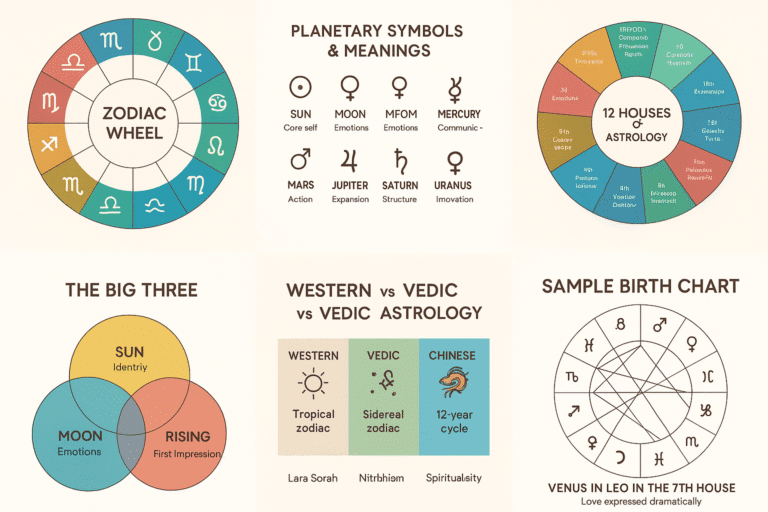
At its core, a natal chart is a symbolic representation of the sky divided into 12 zodiac signs and 12 houses, showing exactly where the planets were when you were born. Think of it as your personal cosmic fingerprint. It is a map entirely unique to you, capturing the energetic potential of your life path. Unlike the generic horoscopes you might read in magazines, a natal chart looks at the complete, complex picture of who you are.
The Building Blocks of Your Cosmic Blueprint
To truly read a natal chart, you must understand the four foundational pillars of astrology: the signs, the planets, the houses, and the aspects. Together, they create the complex psychological profile that makes you who you are.
The 12 Zodiac Signs
The zodiac signs act as the stylistic overlay of your chart. If the planets are the “what,” the signs are the “how.” They describe the specific flavor and energy a planet expresses.
Aries (March 21 – April 19): Fire element, Cardinal modality. Aries represents the pioneer. It is bold, impulsive, energetic, and driven by a need for independence and action.
Taurus (April 20 – May 20): Earth element, Fixed modality. Taurus brings grounded, steady persistence. It focuses on security, sensuality, patience, and material comfort.
Gemini (May 21 – June 20): Air element, Mutable modality. Gemini is the communicator. It is adaptable, curious, intellectual, and constantly seeking new information and social exchange.
Cancer (June 21 – July 22): Water element, Cardinal modality. Cancer is the nurturer. It is deeply emotional, intuitive, protective, and focused on home, family, and inner security.
Leo (July 23 – August 22): Fire element, Fixed modality. Leo is the performer. It is charismatic, creative, warm-hearted, and driven by a need for self-expression and recognition.
Virgo (August 23 – September 22): Earth element, Mutable modality. Virgo is the analyst. It is practical, detail-oriented, service-driven, and focused on improvement and organization.
Libra (September 23 – October 22): Air element, Cardinal modality. Libra is the diplomat. It seeks harmony, beauty, fairness, and thrives in partnerships and social connections.
Scorpio (October 23 – November 21): Water element, Fixed modality. Scorpio is the transformer. It is intense, passionate, secretive, and drawn to the deep, psychological truths of life.
Sagittarius (November 22 – December 21): Fire element, Mutable modality. Sagittarius is the explorer. It is optimistic, philosophical, adventurous, and driven by a quest for meaning and freedom.
Capricorn (December 22 – January 19): Earth element, Cardinal modality. Capricorn is the achiever. It is disciplined, ambitious, highly structured, and focused on long-term goals and legacy.
Aquarius (January 20 – February 18): Air element, Fixed modality. Aquarius is the visionary. It is rebellious, innovative, humanitarian, and values individuality and collective progress.
Pisces (February 19 – March 20): Water element, Mutable modality. Pisces is the mystic. It is compassionate, highly intuitive, imaginative, and deeply connected to the spiritual and emotional realms.
The Planets
In astrology, the planets represent psychological drives or fundamental human forces. They are the active agents in your chart.
The Sun: Represents your core identity, your ego, and your conscious will. It is the life force that drives your overarching life purpose.
The Moon: Governs your emotional landscape, your instincts, and your subconscious. It dictates how you nurture yourself and what you need to feel safe.
Mercury: The planet of the mind. It rules communication, intellect, logic, and how you process information and express your thoughts.
Venus: The planet of love and aesthetics. It dictates your values, how you experience pleasure, what you find beautiful, and your approach to romantic relationships.
Mars: The planet of action and desire. It represents your raw physical energy, your drive, your ambition, and how you assert yourself and handle conflict.
Jupiter: The planet of expansion and luck. It rules higher learning, philosophy, optimism, and where you experience natural growth and abundance in life.
Saturn: The planet of restriction and discipline. It highlights your responsibilities, life lessons, boundaries, and where you must work hard to build lasting foundations.
Uranus: The planet of rebellion and innovation. It brings sudden changes, breakthroughs, and dictates where you demand absolute freedom and authenticity.
Neptune: The planet of dreams and spirituality. It rules illusion, imagination, mysticism, and where you might struggle with boundaries or experience profound spiritual connection.
Pluto: The planet of transformation and power. It governs the cycles of death and rebirth, revealing where you face deep psychological shifts and profound evolution.
The 12 Houses
If the planets are the actors and the signs are the costumes, the houses are the stages where the action takes place. The chart is divided into 12 distinct domains of life experience.
1st House (House of Self): Governs your physical appearance, your self-image, and the immediate first impression you make on the world.
2nd House (House of Value): Rules your personal finances, material possessions, and your deep-seated sense of self-worth.
3rd House (House of Communication): Dictates your immediate environment, siblings, short-distance travel, early education, and everyday communication style.
4th House (House of Home): Represents your roots, your ancestors, your private domestic life, and your foundational psychological security.
5th House (House of Pleasure): Rules over creativity, romance, self-expression, children, and how you naturally experience joy and playfulness.
6th House (House of Health): Governs your daily routines, your work environment, physical health, acts of service, and everyday habits.
7th House (House of Partnerships): The domain of one-on-one relationships, including marriage, serious business partnerships, and open enemies.
8th House (House of Transformation): Rules shared resources, inheritances, intimacy, psychology, and the profound mysteries of life, death, and rebirth.
9th House (House of Philosophy): Dictates higher education, long-distance travel, religion, publishing, and your overarching worldview.
10th House (House of Career): Represents your public reputation, your professional achievements, and the legacy you aim to leave behind in society.
11th House (House of Friendships): Rules your social networks, group associations, humanitarian efforts, and your greatest hopes and wishes for the future.
12th House (House of the Subconscious): The most hidden part of the chart. It governs isolation, spirituality, hidden enemies, karmic cycles, and mental health.
The Major Aspects
Aspects are the precise geometric angles between the planets in your chart. They describe how the different parts of your psyche interact with one another.
Conjunction (0°): When two planets sit in the same exact spot. Their energies are fused together, acting as a single, highly concentrated force that can be a massive strength or a blind spot.
Sextile (60°): A highly cooperative, flowing aspect. It highlights natural talents and opportunities, but requires conscious effort to activate and fully utilize.
Square (90°): An aspect of tension and friction. Squares represent internal clashes between different planetary drives. However, this tension is exactly what forces you to take action and grow.
Trine (120°): The most harmonious aspect. Trines represent effortless flow, natural luck, and profound talents. The energy moves so easily that you might take it for granted.
Opposition (180°): When planets are exactly across the chart from one another. This creates a push-and-pull dynamic, demanding that you find balance and integration between two polarizing forces.
Decoding the “Big Three”: Sun, Moon, and Rising Sign
While many people only know their Sun sign, your astrological identity is actually anchored by three vital placements.
Your Sun Sign represents your essence, your ego, and your conscious will. It is the core of who you are learning to become in this lifetime.
Your Moon Sign speaks to your emotional self, your deepest needs, and your intuition. It is the private side of your personality that you typically only reveal to those closest to you.
Your Rising Sign, or Ascendant (the cusp of the 1st House), is the mask you wear and how others perceive you. It represents your outward style and the energetic first impression you make on the world.
Together, these three placements form the foundation of your astrological profile.
How a Western Natal Chart Is Calculated
Creating an accurate natal chart requires three precise details: your date of birth, your exact time of birth, and your location of birth. With this information, astrologers and software calculate planetary positions using an ephemeris, which is a table of planetary motions.
Western astrology utilizes the tropical zodiac, which is aligned with Earth’s seasons rather than the actual shifting constellations in the sky. For instance, if someone was born on July 5, 1990, at 3:15 PM in New York City, their Sun would be in Cancer, their Moon might fall in Sagittarius, and their Rising sign could be Scorpio. Astrologers look at this precise combination to build a holistic interpretation.
Step-by-Step Chart Interpretation
Interpretation is the true heart of astrology. When reading a chart, you start by identifying the Big Three to grasp the personality fundamentals. Next, you examine specific planetary placements within the signs and houses. For example, if Venus is placed in Taurus in the 2nd House, it suggests a deeply grounded approach to love, coupled with a strong desire for financial security and aesthetic beauty.
From there, you study the aspects. A chart with Mars squaring Saturn might indicate a lifelong struggle balancing aggressive ambition with structural restriction. Finally, you look at house placements to see where life themes are heavily concentrated. This layered approach reveals a complex web of patterns and tendencies, rather than a rigid, inescapable fate.
Comparing Western Astrology to Other Traditions
Astrology is not a monolith, and different cultures have developed incredibly rich, unique systems.
Western astrology is heavily focused on psychological development, personality, and life patterns. It uses the tropical zodiac, placing a strong emphasis on the Sun, Moon, and Ascendant.
Vedic astrology, also known as Jyotish, originates from ancient India and uses the sidereal zodiac, which aligns with the fixed stars. It places a much heavier emphasis on the Moon and the Ascendant than the Sun. Vedic astrology is deeply rooted in concepts of karma, dharma, and spiritual lessons, utilizing specific planetary periods called dashas for highly accurate predictive work.
Chinese astrology operates on an entirely different framework based on the lunar calendar. It utilizes a 12-year cycle represented by zodiac animals and incorporates the five elements (Wood, Fire, Earth, Metal, Water) and Yin/Yang philosophy. Its primary focus is on personality traits, cyclical fortune, and compatibility.
Frequently Asked Questions
1. What is the difference between a birth chart and a natal chart?
There is actually no difference between the two. The terms birth chart and natal chart are completely interchangeable in the astrological community. Both refer to the exact same cosmic snapshot of the sky, calculated using the precise date, time, and location of your birth.
2. What is the best way to approach astrology for beginners?
The most effective approach to astrology for beginners is to start small and avoid overwhelming yourself. Focus entirely on understanding your “Big Three” (your Sun, Moon, and Rising signs) before you attempt to dive into complex planetary aspects or the nuanced meanings of the 12 houses. Mastering these foundational elements provides a strong, intuitive grasp of your overarching personality profile.
3. Can anyone learn how to read a birth chart?
Absolutely. Learning how to read a birth chart is very much like learning a new language. It simply requires familiarizing yourself with the basic vocabulary—the signs, the planets, and the houses—and then practicing how those distinct elements interact with one another to form a narrative. With patience and consistent practice, anyone can decode their cosmic blueprint.
4. How does Western astrology differ from astronomy?
While astronomy is the objective, scientific study of the physical universe and celestial bodies, Western astrology is a symbolic language utilized to find personal meaning and psychological insight. Rather than treating planetary movements as physical forces that cause events on Earth, modern astrological practice often draws on Carl Jung’s framework of archetypes to help individuals process their deep-seated emotions, behavioral patterns, and personal growth.
How to Use Your Natal Chart for Personal Growth
In the modern Western world, astrology is widely utilized as a powerful tool for self-awareness and psychological growth rather than fortune-telling. It helps individuals understand their inherent strengths, shadow traits, and hidden drives. It offers guidance for career paths by identifying natural talents, and it provides profound insights into relationship dynamics by exploring zodiac compatibility through chart comparison.
A natal chart is far more than a simple horoscope; it is a rich, symbolic map of your inner world. By taking the time to explore your cosmic blueprint, you empower yourself to understand your true nature, embrace your potential, and make highly conscious choices on your life’s journey.
About the Author
Cosmic Signs Daily Editorial Board
The Cosmic Signs Daily Editorial Board ensures every article is researched, fact-checked, and reviewed for accuracy. Our team relies on precise astronomical data to provide grounded and reliable spiritual guidance.
Follow our journey on Pinterest.
Disclaimer
The information provided in this article is intended for educational and reflective purposes only. Astrology is interpretive and symbolic in nature; it should not be regarded as a guarantee of outcomes. This content does not constitute professional financial, legal, medical, or psychological advice. Decisions remain solely your responsibility. For guidance on specific circumstances, please consult a qualified professional. Read full Terms & Conditions.