
Beyond the Big Three: How Planetary Aspects Shape Your Personality and Your Love Life
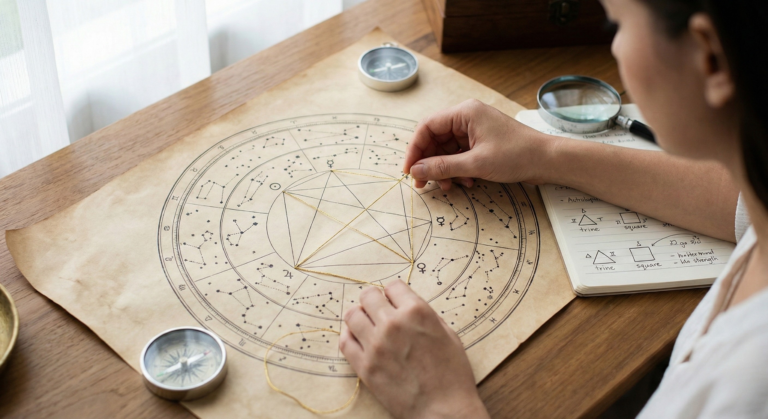
Most people start their astrology journey with the “Big Three”: Sun, Moon, and Rising. This is like knowing the actors in a movie (the Planets) and the costumes they are wearing (the Signs).
But a movie isn’t just actors standing around in costumes. They need a script. They need to interact, fight, fall in love, and debate.
In astrology, that script is determined by Planetary Aspects.
While the signs describe how a planet behaves, the aspects describe how the planets talk to one another based on their geometric angles in the sky. For example, if you have Venus (representing love and values) forming a hard angle to Saturn (restriction), that specific geometry will play out in your relationships. If you have ever felt like two parts of your personality are constantly at war, that isn’t a mistake—it is the specific aspect conversation happening in your chart.
Table of Contents
ToggleThe “Big Five”: Decoding Your Internal Wiring
Imagine your birth chart is a boardroom table. The planets are the people sitting at that table. Aspects describe how they talk to each other.
In Western astrology, we look at five major angles (The Ptolemaic Aspects). Here is your cheat sheet to the vibes they create.
1. The Conjunction (0°) – The Fusion
The Vibe: Intensity, Focus, “All or Nothing.” The Setup: Two planets sitting side-by-side in the same seat.
Think of a Sun-Mars Conjunction. Your Identity (Sun) is glued to your Action (Mars). You don’t just have energy; you are energy.
The Superpower: Incredible focus. You are a self-starter who gets things done.
The Blind Spot: Subjectivity. Because these planets are fused, you can’t see them separately. You might be aggressive without realizing it because, to you, that’s just “breathing.”
2. The Opposition (180°) – The Mirror
The Vibe: Tension, Awareness, Relationship. The Setup: Two planets staring each other down from opposite sides of the table.
This is a cosmic tug-of-war. If you have a Moon-Mercury Opposition, your Heart (Moon) and Head (Mercury) are constantly debating. When you feel, you can’t think. When you think, you disconnect from your feelings.
The Lesson: Balance. People with oppositions often “project” one side onto others. You might be overly logical and attract overly emotional partners to act out the other side of the see-saw.
3. The Trine (120°) – The Flow State
The Vibe: Harmony, Luck, Laziness. The Setup: Planets dealing in the same element (Fire to Fire, Water to Water).
The Trine is the cosmic “Green Light.” The energy flows without friction.
The Trap: We love Trines, but they can make us lazy. If you have a Venus-Jupiter Trine, you might be naturally charming and lucky with money. But because it comes easy, you might never develop the grit to maintain it. Trines are talents we take for granted.
4. The Square (90°) – The Turning Point
The Vibe: Friction, Action, Crisis. The Setup: Planets at a sharp right angle. They are blocking each other’s path.
Don’t let the fear-mongering scare you: Squares are where success happens. A Square creates an itch you have to scratch. It is tension that demands resolution.
The Reality: High-achievers almost always have Squares in their charts. A Mars-Saturn Square feels like driving with the parking brake on (Stop/Go energy). But mastering that tension teaches you disciplined endurance that Trine people can only dream of.
5. The Sextile (60°) – The Opportunity
The Vibe: Excitement, Support, Potential. The Setup: Planets that are friendly, but not fused.
A Sextile is like a tool sitting on a workbench. It’s useful, but only if you pick it up. Unlike the Trine (which flows automatically), a Sextile requires you to flip the switch. It represents a skill you can learn easily if you put in the effort.
The Chemistry of Us: Aspects in Relationships (Synastry)
Here is where it gets juicy. We don’t just have aspects within ourselves; we form aspects with other people.
When you overlay your chart on top of your partner’s chart (a technique called Synastry), you can see the geometric geometry of your relationship.
1. The “Soulmate” Link: Sun-Moon Conjunction When your Sun (Identity) is conjunct their Moon (Emotions), or vice versa, the connection is instant. You feel “seen” (Sun) and “safe” (Moon). It’s the classic “I feel like I’ve known you forever” aspect.
2. The “Hot and Cold” Link: Venus-Mars Square This is the hallmark of a rom-com relationship. There is intense sexual chemistry and friction. The sparks fly, but so do the arguments. It’s exciting in the short term, but without stabilizing aspects, the fire can burn the house down.
3. The “Glue”: Saturn Aspects In American dating culture, Saturn gets a bad rap as the “buzzkill.” But in Synastry? Saturn is the ring. Soft aspects (Trines/Sextiles) from one person’s Saturn to another’s personal planets provide the stability needed for a long-term marriage. Without Saturn, you have a summer fling; with Saturn, you have a 50th anniversary.
Navigating Real-Time Planetary Aspects
While your birth chart is a fixed snapshot of the sky, the universe doesn’t stand still. The planets are constantly moving, forming new Planetary Aspects every single day. This creates the “cosmic weather” we all experience collectively.
Have you ever had a day where everyone seemed irritable for no reason? That was likely a hard aspect (like a Square) activating the sky. Conversely, days where opportunities seem to fall into your lap are often triggered by supportive Trines. To understand the specific energy influencing your mood and choices right now, check our live guide to Current Planetary Positions. Keeping an eye on the moving sky helps you plan your week—scheduling difficult tasks for focused days and creative projects for flowing days.
The Bottom Line: You Are The Architect
The most important thing to remember is that “Bad Aspects” don’t exist.
Soft Aspects (Trines/Sextiles) show us where we can rest and recharge.
Hard Aspects (Squares/Oppositions) show us where we are meant to grow and build muscle.
Your chart isn’t a life sentence; it’s a blueprint. The aspects show you where the walls, windows, and doors are located. But you? You’re the one living in the house. You decide whether to bang your head against the wall or open the window.
Frequently Asked Questions about planetary aspects
1. How do I know if I have a "hard" or "soft" chart?
Most people have a mix of both! A “hard” chart would have mostly Squares and Oppositions, indicating a life full of action, challenges, and high growth potential. A “soft” chart features mostly Trines and Sextiles, indicating natural talents and a smoother flow of life. Neither is better than the other; they just require different strategies to navigate.
2. What does it mean if a planet has no aspects?
This is called an “unaspected planet.” It is rare and fascinating. An unaspected planet is like a “wild card” or a lone wolf. Because it isn’t talking to any other planets, it can act in unpredictable ways—switching between being completely dormant and suddenly taking over your entire personality.
3. What is an "Orb" and why does it matter?
An “orb” is the wiggle room we give an aspect. For example, a perfect Square is 90°. But if two planets are 88° apart, we still count it as a Square with a “2-degree orb.”
-
Tight Orbs (0°–2°): Extremely powerful and felt constantly.
-
Wide Orbs (6°–10°): The energy is there, but it is more subtle or background noise.
4. Do my aspects change as I get older?
Your Natal aspects (the ones you were born with) never change; they are your permanent factory settings. However, moving planets in the sky (Transits) form temporary aspects to your natal planets every day, which triggers the events and moods you experience throughout your life.
About the Author
Cosmic Signs Daily Editorial Board
The Cosmic Signs Daily Editorial Board ensures every article is researched, fact-checked, and reviewed for accuracy. Our team relies on precise astronomical data to provide grounded and reliable spiritual guidance.
Follow our journey on Pinterest.
Disclaimer
The information provided in this article is intended for educational and reflective purposes only. Astrology is interpretive and symbolic in nature; it should not be regarded as a guarantee of outcomes. This content does not constitute professional financial, legal, medical, or psychological advice. Decisions remain solely your responsibility. For guidance on specific circumstances, please consult a qualified professional. Read full Terms & Conditions.