
Zodiac Sign Dates: A Global Cosmic Journey
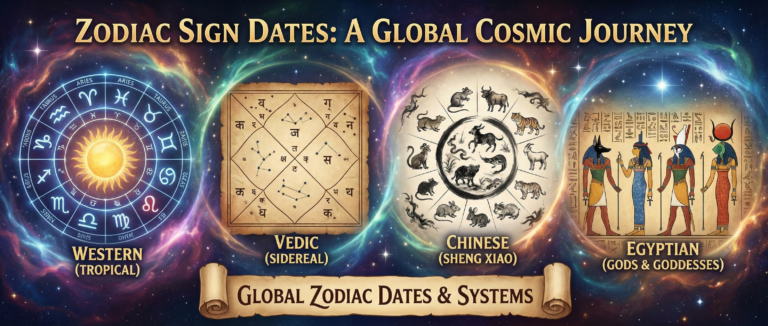
Understanding your Zodiac Sign Dates is the foundational step in interpreting the language of the stars. While most people are familiar with the standard 12-sign calendar used in Western culture, the cosmos has been mapped in diverse ways by civilizations throughout history. Depending on whether you look to the seasons, the fixed stars, or lunar cycles, the timeline of your cosmic identity can shift dramatically. Let’s embark on a journey through time and tradition to explore the specific dates and signs across Western, Vedic, Chinese, Egyptian, and Hellenistic astrology.
Table of Contents
ToggleWestern Astrology: The Tropical Zodiac
This is the system most commonly used in the Western world, including the US. It’s based on the tropical zodiac, which is aligned with the Earth’s seasons. The year begins with the Spring Equinox, marking the start of Aries.
| Zodiac Sign | Symbol | Dates |
| Aries | The Ram | March 21 – April 19 |
| Taurus | The Bull | April 20 – May 20 |
| Gemini | The Twins | May 21 – June 21 |
| Cancer | The Crab | June 22 – July 22 |
| Leo | The Lion | July 23 – August 22 |
| Virgo | The Maiden | August 23 – September 22 |
| Libra | The Scales | September 23 – October 23 |
| Scorpio | The Scorpion | October 24 – November 21 |
| Sagittarius | The Archer | November 22 – December 21 |
| Capricorn | The Goat | December 22 – January 19 |
| Aquarius | The Water Bearer | January 20 – February 18 |
| Pisces | The Fishes | February 19 – March 20 |
Vedic Astrology (Jyotish): The Sidereal Zodiac
Vedic astrology, originating in ancient India, uses the sidereal zodiac. This system is based on the actual positions of the constellations in the sky. Because of the Earth’s precession (a slow wobble on its axis), the sidereal zodiac has shifted over time relative to the tropical zodiac. As a result, your Vedic sign is likely one sign back from your Western sign.
| Zodiac Sign (Sanskrit Name) | Western Equivalent | Approximate Dates |
| Mesha | Aries | April 14 – May 14 |
| Vrishabha | Taurus | May 15 – June 14 |
| Mithuna | Gemini | June 15 – July 15 |
| Karka | Cancer | July 16 – August 16 |
| Simha | Leo | August 17 – September 16 |
| Kanya | Virgo | September 17 – October 16 |
| Tula | Libra | October 17 – November 15 |
| Vrishchika | Scorpio | November 16 – December 15 |
| Dhanu | Sagittarius | December 16 – January 13 |
| Makara | Capricorn | January 14 – February 12 |
| Kumbha | Aquarius | February 13 – March 13 |
| Meena | Pisces | March 14 – April 13 |
Chinese Astrology: The Sheng Xiao
Unlike Western and Vedic astrology which are based on months, Chinese astrology is based on a 12-year lunar cycle. Each year is represented by an animal. Your sign is determined by the year of your birth.
| Animal Sign | Recent & Upcoming Years | Personality Traits |
| Rat | 2020, 2032 | Quick-witted, resourceful, versatile |
| Ox | 2021, 2033 | Diligent, dependable, strong, determined |
| Tiger | 2022, 2034 | Brave, confident, competitive |
| Rabbit | 2023, 2035 | Quiet, elegant, kind, responsible |
| Dragon | 2024, 2036 | Confident, intelligent, enthusiastic |
| Snake | 2025, 2037 | Enigmatic, intelligent, wise |
| Horse | 2026, 2038 | Animated, active, energetic |
| Goat | 2027, 2039 | Calm, gentle, sympathetic |
| Monkey | 2028, 2040 | Sharp, smart, curiosity |
| Rooster | 2029, 2041 | Observant, hardworking, courageous |
| Dog | 2030, 2042 | Lovely, honest, prudent |
| Pig | 2031, 2043 | Compassionate, generous, diligent |
Egyptian Astrology
Ancient Egyptian astrology is one of the oldest forms of astrology. Its signs are based on gods and goddesses, and unlike other systems, each sign covers multiple date ranges throughout the year.
| Egyptian Sign | Dates | Key Traits |
| The Nile | Jan 1-7, Jun 19-28, Sep 1-7, Nov 18-26 | Logical, peaceful, practical |
| Amun-Ra | Jan 8-21, Feb 1-11 | Confident, optimistic, leaders |
| Mut | Jan 22-31, Sep 8-22 | Nurturing, protective, loyal |
| Geb | Feb 12-29, Aug 20-31 | Sensitive, open, reliable |
| Osiris | Mar 1-10, Nov 27-Dec 18 | Strong, independent, determined |
| Isis | Mar 11-31, Oct 18-29, Dec 19-31 | Honest, friendly, romantic |
| Thoth | Apr 1-19, Nov 8-17 | Wise, creative, problem-solvers |
| Horus | Apr 20-May 7, Aug 12-19 | Brave, ambitious, optimistic |
| Anubis | May 8-27, Jun 29-Jul 13 | Confident, creative, introverted |
| Seth | May 28-Jun 18, Sep 28-Oct 2 | Bold, perfectionist, seeks change |
| Bastet | Jul 14-28, Sep 23-27, Oct 3-17 | Charming, affectionate, seeks balance |
| Sekhmet | Jul 29-Aug 11, Oct 30-Nov 7 | Disciplined, fair, protective |
Hellenistic Astrology
Hellenistic astrology is the ancestor of modern Western astrology. Developing in the Mediterranean region around the 1st century BCE, it synthesized Babylonian and Egyptian traditions. While it used the same 12 zodiac signs we know today, its techniques and philosophical underpinnings were quite different. The dates for the signs would have been similar to the modern tropical zodiac, as it was also based on the seasons. However, it placed a greater emphasis on the planets’ condition, house placements (using whole sign houses), and the concept of “sects” (day vs. night charts). It’s a fascinating field of study for those interested in the roots of Western astrological practice.
Exploring these different astrological systems offers a broader perspective on how humanity has sought to understand itself through the cosmos. Whether you’re a fiery Aries, a steadfast Ox, or born under the protection of Isis, the stars have a unique story to tell about you.
Frequently Asked Questions About Zodiac Sign Dates
Q: Why do my Zodiac Sign Dates differ between Western and Vedic astrology?
A: This is the most common confusion for astrology enthusiasts. Western astrology uses the “Tropical Zodiac,” which is fixed to the seasons (beginning with the Spring Equinox). Vedic astrology uses the “Sidereal Zodiac,” which is tied to the actual constellations in the sky. Because the Earth wobbles on its axis (a process called precession), the constellations have shifted backward over the last 2,000 years. This is why your Vedic sign is often one sign prior to your Western sign.
Q: I was born on the cusp. How do I know which sign I really am?
A: If your birthday falls on the changing date (the cusp), your sign depends on the exact time and location of your birth. The sun moves into a new sign at a specific minute each year, which varies slightly. To confirm your true sun sign, you should generate your specific map using our Free Birth Chart Calculator.
Q: Did NASA change the Zodiac Sign Dates to include Ophiuchus?
A: No, the astrological signs have not changed. This is a common myth that resurfaces every few years. NASA studies astronomy (the stars), not astrology (the symbolism). While the constellation Ophiuchus exists in the path of the sun, Western astrology is a geometric system based on 12 equal sectors of seasonal time, not the uneven sizes of constellations. You can read more about the difference between constellations and astrological signs on NASA’s Space Place.
Q: How are Chinese Zodiac Sign Dates determined?
A: unlike Western astrology, which changes monthly, the Chinese Zodiac changes annually based on the Lunar New Year. This date usually falls between January 21 and February 20. If you were born in January or early February, you must check the specific Lunar New Year date for your birth year, as you might belong to the animal sign of the previous year.
Beyond the Calendar
Exploring the different Zodiac Sign Dates reveals that astrology is not a one-size-fits-all discipline, but a vast, multicultural language of symbols. Whether you resonate most with your Western Sun sign, your Vedic Moon sign, or your Chinese animal year, each system offers a unique lens through which to view your strengths, challenges, and destiny.
By understanding where you fit into these various cosmic timelines, you gain a more complete picture of your spiritual blueprint. Don’t stop here—use this knowledge to compare your profiles and see which ancient wisdom speaks loudest to your current journey. For deeper insights into how these energies affect your day-to-day life, be sure to explore our daily forecasts here at Cosmic Signs Daily.

About the Author
Cosmic Signs Daily Editorial Board
The Cosmic Signs Daily Editorial Board ensures every article is researched, fact-checked, and reviewed for accuracy. Our team relies on precise astronomical data to provide grounded and reliable spiritual guidance.
Follow our journey on Pinterest.
Disclaimer
The information provided in this article is intended for educational and reflective purposes only. Astrology is interpretive and symbolic in nature; it should not be regarded as a guarantee of outcomes. This content does not constitute professional financial, legal, medical, or psychological advice. Decisions remain solely your responsibility. For guidance on specific circumstances, please consult a qualified professional. Read full Terms & Conditions.