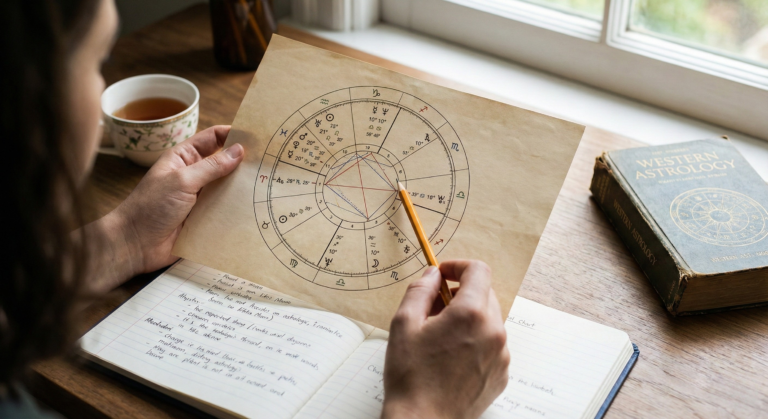
If you have ever looked up at the night sky and wondered if the cosmos has a plan for you, you are not alone. But in Western Astrology, we don’t just “wonder”—we calculate.
A Natal Chart (or birth chart) is not just a horoscope; it is a mathematically precise snapshot of the solar system at the exact moment you took your first breath. It is a data-driven map of the heavens, calculated using your specific longitude, latitude, and time of birth.
Learning how to read a birth chart allows you to move beyond the surface level of generic horoscopes. Instead of relying on vague predictions, you gain access to a personalized psychological manual.
Mastering your own birth chart reading might look like deciphering a secret code, but once you understand the variables, it becomes a clear, logical story of you.
Ready to stop guessing and start analyzing? Get your Free Birth Chart here and let’s dive into the data.
Step 1: The Input Data (Why Precision Matters)
Before we read the chart, we must respect the math. Western Astrology uses the Tropical Zodiac, which tracks the planets’ positions relative to the Earth’s seasons.
To get an accurate reading, you need three data points:
Date of Birth: Determines the planetary positions.
Location of Birth: Determines the perspective of the sky.
Time of Birth: The most critical variable.
The Data-Driven Reality: The Earth rotates on its axis once every 24 hours. This means the sky “moves” about 1 degree every 4 minutes. If your birth time is off by just 15 minutes, your Ascendant can shift entirely, changing the layout of your Astrology Houses. Precision is power in astrology.
Step 2: The Big Three: Sun, Moon, and Rising Signs
When you look at your chart wheel, don’t get overwhelmed by the glyphs. Start with the statistical heavyweights—your Sun Moon Rising placements. These three points triangulate your personality.
1. The Sun ☉ (The Core Self)
What it is: The position of the Sun determines your main “Zodiac Sign.”
What it represents: Your ego, your drive, and the “fuel” that burns in your engine. It is who you are when no one is watching.
2. The Moon ☾ (The Inner World)
What it is: The Zodiac sign the Moon was visiting at your birth.
What it represents: Your emotional instincts, your subconscious, and what you need to feel safe. If the Sun is the driver, the Moon is the map.
3. The Ascendant / Rising Sign (The Mask)
What it is: The precise zodiac sign that was rising on the Eastern Horizon at your exact minute of birth.
What it represents: Your first impression, your physical appearance, and the “lens” through which you view the world.
Step 3: The Architecture of the Chart
To read the chart like a pro, think of it as a theater production.
The Planets (The Actors)
The planets are the “who” in the story. Each planet represents a specific psychological drive.
Mercury: Communication and logic.
Venus: Love, values, and money.
Mars: Action and aggression.
The Zodiac Signs (The Costumes)
The signs are the “how.” They “dress up” the planets.
The Astrology Houses (The Stage)
The chart is divided into 12 pie slices called Astrology Houses. Each house represents a specific area of life. The planet’s location tells you where that energy will manifest.
1st House: Self & Identity.
4th House: Home & Family.
7th House: Relationships & Marriage.
10th House: Career & Public Image.
Pro Tip: If you have a “stellium” (3 or more planets) in one house, that area of life is statistically significant for you. It is a major focal point of your destiny.
Step 4: The Aspects (The Geometry of Destiny)
This is where the “data-driven” approach truly shines. The planets form geometric angles to one another called Aspects.